
On 12 November Dávid Vitézy, Hungary’s minister for transport and investment, and Gergely Karácsony, the Mayor of Budapest, signed the agreement under which BKK becomes the joint state and city transport authority for Budapest and its surrounding area from 1 January 2027. At the press conference the minister also described how trains would reach Budapest Liszt Ferenc International Airport and where the railway’s procurement stands.
Where would the airport railway run?
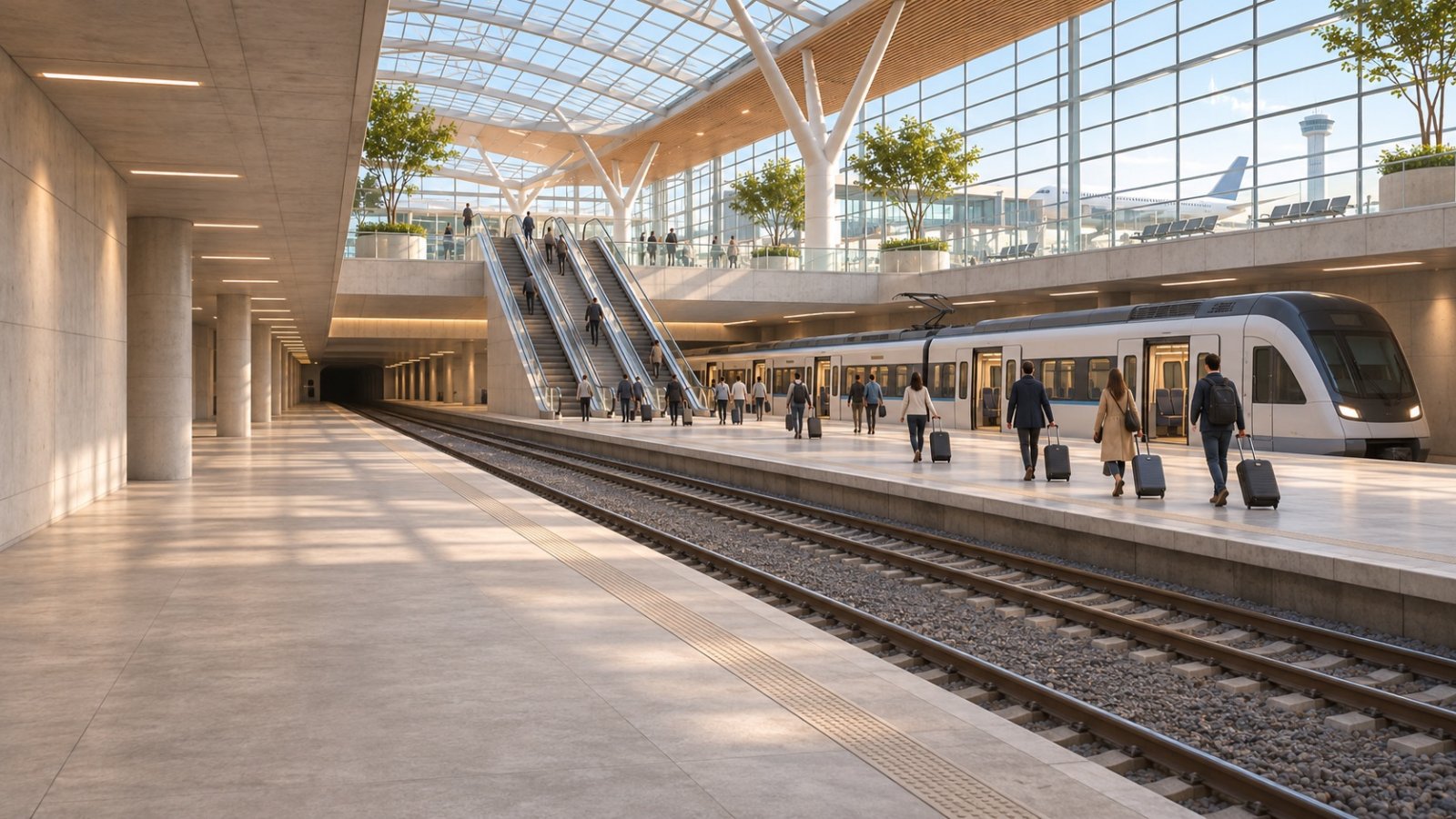
The government backs the version in which trains do not turn back at the airport but run through it. This design has a valid railway authority permit. As the minister described it:
- From Kőbánya-Kispest there would be four tracks instead of today’s two. The two new tracks would branch off at Csévéző utca, where they cross the airport expressway, so the rail and road designs have to be coordinated.
- The double-track line would run between the airport’s two runways and pass in front of Terminal 2, beside today’s Holiday Parking and the two hotels built there.
- An underground station would be built there, from which Terminal 2 and the new terminal building planned on the same site can be reached on foot, fully under cover.
- The line would also pass under the M0 motorway, then come back to the surface, bypass Vecsés and Monor, and join the main line to Szolnok after Monor.
Where could you go by train?
Under the plans, InterRegio and InterCity trains from Debrecen, Nyíregyháza, Szeged, Kecskemét and Cegléd would stop at the airport and continue through Zugló to Nyugati railway station. Trains from western Hungary (Tatabánya, Győr, the Székesfehérvár line) and from Kelenföld would reach the airport over the Southern Ring Railway, through its new stops at Nádorkert and Közvágóhíd and the Népliget stop to be built soon. A passenger arriving at the airport could:
- take a frequent train to Nyugati railway station;
- travel at least every half hour towards Nádorkert (Kopaszi-gát), Közvágóhíd and Kelenföld, and on to the western suburbs;
- reach the large cities of eastern Hungary without changing trains.
The exact timetable and the fare are not yet known.
Where does the procurement stand?
According to the minister, the project will cost several hundred billion forints, and a concession procurement for building it is under way. In the participation stage, the period for completing the applications ends in late November. The names of those who go through to the second round will then be published, and the bidding stage, which seeks the contractor or concessionaire to build the railway, starts in early 2027. “In procurement terms, the railway is ahead of the road,” Dávid Vitézy said. He did not say when construction could start or when the first trains could run.
The western link also needs the Southern Ring Railway
Trains from Kelenföld would come over the Southern Ring Railway, whose construction contract with V7 Zrt. the ministry has suspended. Surveys are now establishing what work has been done and what is needed so that the unfinished structures are not damaged. The minister aims to issue the new construction tender in the first half of 2027, realistically in the second quarter; in the most optimistic scenario a new contractor could be in place by early 2028.
Bus lanes on the expressway
We wrote about the rebuilding of the airport expressway in an earlier article. At the press conference the minister added that bus lanes would be built in places along the 11-kilometre stretch, and that the underpasses and overpasses that today carry one lane in each direction would carry two. He puts the cost at between 100 and 200 billion forints. Work could start in the second half of 2028 if all goes well, or in 2029 at a slower pace, and would proceed in sections so that the restrictions do not all come at once.
A regional BKK from 1 January
From 1 January 2027 BKK will be owned half by the state and half by the city. Its official name becomes Budapesti Várostérségi Közlekedési Központ (Budapest Metropolitan Area Transport Centre); the BKK abbreviation and logo stay. BKK will then order all HÉV suburban rail services, the blue Volánbusz routes, and the yellow Volánbusz routes that start in Budapest and do not leave Pest County. Long-distance buses that cross the county border will still be ordered by the state.
The network will change step by step. The minister said the bus network could be reshaped quickly in the nearby suburbs, for example around Érd, Dunakeszi, Maglód and Gyömrő, with the aim of buses running as often in the evenings and at weekends as they do in Budapest’s outer districts. Over the next two years the MÁV group will put 250 new buses into service in the suburbs, plus 150 more from a separate purchase, already in BKK blue and with BKK’s passenger information; BKK’s FUTÁR real-time information will also cover the suburbs.
One ticket instead of three
Today three kinds of ticket are needed: a BKK single ticket on BKK buses; a HUF 400 ticket on blue Volánbusz routes that cross the city boundary, sold only for cash by the driver; and a distance-based ticket on yellow Volánbusz routes, sold only by MÁV. The government and the city want to merge the three in the coming months; the minister said this will be one of the first visible results of the regional BKK. When, and at what price, is not yet known.
What does this mean for airport travellers?
- Nothing changes for now. When the railway will be built and opened is not known, and the 100E and 200E buses were not mentioned at the press conference.
- Travellers coming to the airport from the suburbs may benefit from the single ticket and more frequent buses; BKK has not yet said from when.
- We show the 100E and 200E departures on our public transport page, and the trip to the airport can be planned with our journey planner.
Source: Vitézy Dávid, közlekedési és beruházási miniszter (YouTube)