
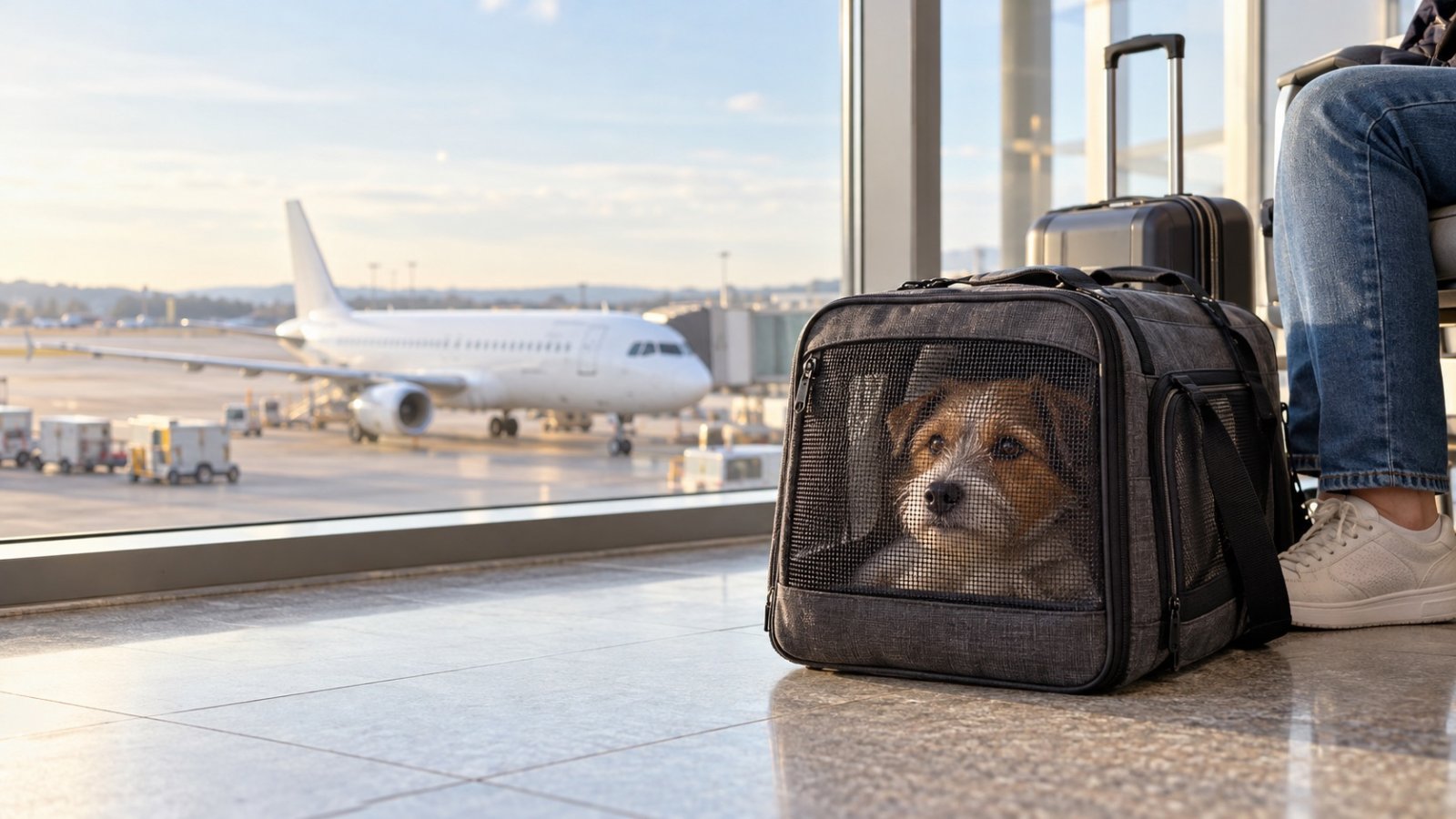
Anyone planning to fly from Budapest with a dog or a cat should check which airline accepts animals at all before buying a ticket. From 22 October 2026, LOT Polish Airlines sets out its conditions for carrying animals in a new, separate set of rules. Here is what they say, what the two largest low-cost airlines at Budapest say, and what the EU's basic rules require.
At a glance
| Wizz Air | Ryanair | LOT | |
|---|---|---|---|
| Dog or cat in the cabin | no | no | yes, up to 8 kg including the carrier |
| Dog or cat in the hold | no | no | yes, in an IATA-standard crate |
| Assistance dog | yes, free, one per flight | yes, free, up to four per flight | not covered by the new rules |
| Advance notice | at booking, with the papers at least 48 hours before departure | preferably on the day of booking | at booking, at the latest 12 hours before departure |
Wizz Air: assistance dogs only
According to Wizz Air's special assistance page, no animals other than assistance dogs are carried on board, and emotional support animals are not accepted either. An assistance dog travels free of charge on flights within the European Union and on flights from the EU to countries outside it, but only one dog is accepted per flight, and it may not occupy a seat. The dog must be declared at booking, and the Special Assistance Call Centre must also be told, by phone or e-mail. A certificate showing that the dog is a certified assistance dog, and the papers the countries of departure and destination require, must be sent at least 48 hours before departure.
Ryanair: assistance dogs only, on certain routes
Ryanair's help centre is clear: "We do not carry animals on board any Ryanair flights, except guide/assistance dogs on certain routes." Its detailed conditions say:
- the dog must be certified by a full member of Assistance Dogs International, Assistance Dogs UK or the International Guide Dog Federation; therapy and emotional support dogs may not travel;
- up to four assistance dogs are allowed per flight; the dog, its containers and its food travel free;
- the dog travels in the cabin, on the floor at its owner's feet, wearing an identifying jacket or harness; the owner brings the harness, which is attached to the seat belt for take-off, landing and turbulence;
- the dog should be declared preferably on the day of booking, online or through Ryanair's assisted travel team; without notice, travel can be refused at the airport;
- assistance dogs may travel on all Ryanair flights within the EU and EEA and on domestic flights, but not to or from Morocco or Israel.
LOT: dogs, cats and ferrets, under new rules from 22 October
LOT flies from Budapest to Warsaw, where its network continues. Under the rules in force from 22 October, LOT carries dogs, cats and ferrets for non-commercial purposes in the cabin or in the hold; other animals, and animals being sold, only as cargo. There is a charge, shown during booking on lot.com. The number of places for animals is limited on each aircraft type, so LOT asks passengers to check availability when booking, at the latest 12 hours before departure ("Manage your booking" on lot.com, or the app). LOT's announcement does not say what has changed from the previous rules.
In the cabin
- One passenger may take one animal; two small animals of the same species may share one carrier if together they stay within the weight limit.
- The animal and its carrier (or soft bag) together may weigh at most 8 kg.
- The maximum carrier size depends on the aircraft: 45 × 30 × 20 cm on Embraer jets (E70, E75, E90, E95), and 55 × 40 × 20 cm on the Boeing 737 and 787 Dreamliner. LOT's Budapest flights have recently been operated by Embraer 175 and 195 aircraft, so it is safest to plan for the smaller size.
- The animal must stay in the carrier for the whole flight, with no part of its body sticking out; for take-off, landing and turbulence the carrier goes under the seat in front.
- A passenger with an animal in the cabin may not sit in the first row (on the Dreamliner the first row of each class, on other aircraft the first row of Business Class), nor in an emergency exit row.
In the hold
- Only a rigid crate that meets the IATA Live Animals Regulations is accepted: fibreglass, metal, rigid plastic, solid wood or plywood, without wheels, and not made entirely of mesh. It must be ventilated on at least three sides, have water and food containers, and have an absorbent lining on the floor.
- The maximum crate size is 102 × 69 × 76 cm on Embraer and Boeing 737 aircraft, and 122 × 81 × 89 cm on the Dreamliner and Boeing 777.
- One animal per crate; the exception is up to three young animals from the same litter, at most 6 months old.
- Short-nosed (brachycephalic) dogs and cats, including crossbreeds and animals with similar features, may not travel in the hold because of the risk of hypoxia and circulatory problems: only in the cabin (if they fit the weight and size limits) or as cargo.
Papers and age
At check-in LOT asks for up-to-date vaccination records (including rabies), a pet passport issued by a vet, and proof that a microchip has been implanted. The animal must be at least 3 months old, and its last rabies vaccination must have been given at least 21 days earlier. Checking the entry rules of the destination and transit countries is the passenger's job.
If LOT refuses the animal
If the carrier's size, weight or design does not meet the rules, if papers are missing or wrong, or if a short-nosed animal is presented for the hold, LOT may refuse it and keep the fee. If it refuses because of temperature or other conditions affecting the animal's welfare (weather, a seasonal restriction), the passenger chooses: the animal travels in the cabin if it fits the limits, it flies at another time, or the fee is refunded.
The EU's basic rules
Beyond the airline's conditions, the animal must also meet EU rules. For dogs, cats and ferrets travelling between EU countries, Your Europe lists these:
- a microchip (or a clearly readable tattoo applied before 3 July 2011), implanted before the rabies vaccination;
- a rabies vaccination given when the animal was at least 12 weeks old; after the primary vaccination you must wait at least 21 days before travelling;
- a European pet passport, issued by an authorised vet and valid for the animal's life as long as its records (vaccinations, for example) are up to date;
- for dogs going to Finland, Ireland, Malta, Northern Ireland or Norway, a tapeworm treatment 24 to 120 hours (1 to 5 days) before travel, recorded in the passport;
- as a rule, no more than five animals per trip.
For destinations outside the EU the destination country's rules apply, and they are worth checking well before the trip.
Before booking
- Check whether the airline carries animals and where: other airlines fly from Budapest too, each with its own rules.
- Book the animal together with the ticket, since places are limited.
- Measure the carrier and compare it with the limit for the aircraft type. The type is shown on each flight's page, reached from the departures list, but it can change up to the day of departure.
- Sort out the vet's papers in time; after the vaccination there is a wait of at least 21 days.
Source: LOT Polish Airlines